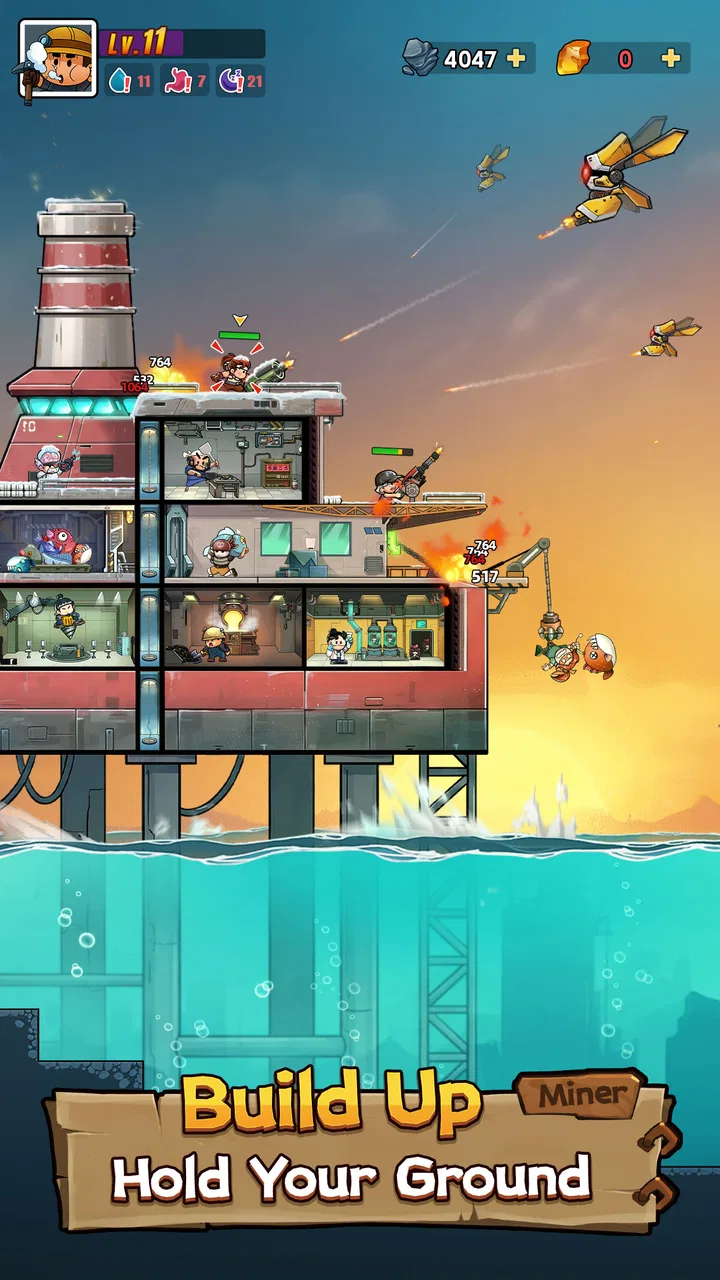
High Seas Hero: Dig & Build
- 4.5
- Rating
- 1.00M
- Installs
- Free
- Price

 Analysis by App-foxy
I approached High Seas Hero: Dig & Build as a quick-play role-playing game rather than something I would sit down with for a long, uninterrupted session. Its appeal is easy to understand: it puts a high-seas survival-and-progression theme into a format that suits short visits, with enough upgrading and decision-making to make returning feel worthwhile. I found it most enjoyable when I treated each visit as a small planning session instead of expecting a deep console-style adventure.
The game is free to start, and it comes from Century Games PTE. LTD. It is listed for Everyone 10+, runs on Android 7.0 or later, and has reached over a million installs. That combination makes it approachable, but the real question is whether its particular rhythm suits you. In my experience, the answer depends less on whether you like pirate imagery and more on whether you enjoy gradual improvement, repeated tasks, and making progress in small pieces.
What the first sessions feel like
The opening hours are designed to get you moving quickly. You are introduced to the central loop, collect what is available, improve your position, and continue toward the next objective. I appreciated that the game does not require a long explanation before giving me something to do. At the same time, that speed can make the early interface feel busy. Several prompts, rewards, upgrade choices, and progress markers compete for attention, so it is tempting to tap through everything without understanding why a particular choice matters.
You May Also Like

 Blood Strike: 2.5 Anniversary
Blood Strike’s Loadouts Turn Every Drop Into a Tactical Gamble
A close look at Blood Strike’s custom loadouts: how fast access to signature weapons reshapes its battle royale rhythm, rewards preparation, and narrows the gap between fights.

 Pandora - Music & Podcasts
Pandora’s Music Is Easy to Start, but Harder to Recover
Pandora’s strength is its low-effort path from a seed to a station. Its weak spot is how much confidence it asks you to place in connection, setup, and quiet recovery.

 8 Ball Pool
 Is Built on Rivalries, Rematches, and Routine
A close look at the rivalries, rematches, shared routines, and unanswered safety questions that turn a quick pool match into a persistent mobile community.

 Samsung Music
’s Quiet Strength Is Playing What You Already Own
Its reach comes less from spectacle than from dependable access to a personal library. That simplicity is both the app’s strongest retention engine and its ceiling.

 AccuWeather: Weather Radar
AccuWeather Review: A Quick, Clear Forecast for Everyday Decisions
For everyday plans, the best forecast is the one you can understand quickly. AccuWeather makes rain timing, radar, and local conditions easy to act on, with a few trade-offs.

 Hill Climb Racing
Why Hill Climb Racing Still Turns Crashes Into One More Run
A tiny car, a bumpy hill and one more upgrade: Hill Climb Racing keeps resurfacing because its simple chaos makes every near-miss feel personal.
More From Our News Desk
View All News


That is the first place where players can get stuck: not because the controls are especially difficult, but because the game presents progress as a stream of small decisions. When I slowed down, I found it easier to separate immediate rewards from choices that would influence my next few sessions. A useful habit is to read the objective before spending anything. If the current task is asking for a particular kind of improvement, spending resources on an unrelated upgrade may make the next step feel slower.
The role-playing structure is better suited to people who enjoy watching a character or crew become stronger over time than to players looking for a highly interactive sailing simulator. I did not approach it as a realistic nautical game. The sea setting gives the progression a clear identity, while the actual satisfaction comes from completing tasks, strengthening your setup, and seeing the next layer of content become manageable.
Where progress can feel less clear
One subtle source of friction is the difference between being busy and being efficient. The game often gives you something to collect or improve, but not every available action has equal value at that moment. I recommend checking the current mission or milestone first, then using the reward from that step to support the next one. This simple order reduces wasted taps and helps prevent the feeling that resources disappear without producing a noticeable result.
I also found that returning after a break can be slightly disorienting. A player may have several unfinished objectives, new rewards, and a stronger character than expected. Rather than opening every menu immediately, I would first check the main progression path, then review any free or earned rewards, and only afterward look at optional improvements. That workflow keeps the session focused and makes it easier to tell what actually moved the game forward.
This matters particularly on a phone used throughout the day. If I opened the game while waiting for transport or taking a short break, I needed a clear stopping point. Completing one objective or handling one upgrade cycle worked better than trying to process every notification at once. The game is more comfortable when treated as a series of compact visits, not as an application that must be fully cleared every time it opens.
Checking the installation before blaming the game
Because the game supports Android 7.0 and newer, compatibility is broad, but that does not guarantee an identical experience on every device. Before assuming that a loading or performance problem comes from the game itself, I would check the basics: confirm that the phone is running a supported Android release, leave enough free storage for normal app operation, and close other demanding applications before launching it.
A fresh installation is also worth giving a clean start. If the first launch seems unusually slow, I would wait rather than repeatedly closing and reopening the game. On a busy or older phone, the initial setup can feel less responsive than later sessions. If the interface remains stuck, restarting the device is a sensible next step. I would avoid clearing app data casually, because that can remove local progress or force the setup process to begin again if the account state is not restored automatically.
Network quality is another practical check. A game built around ongoing progression may behave poorly when the connection changes repeatedly between weak mobile data and unstable Wi-Fi. If rewards or progress appear delayed, I would switch to one reliable connection, reopen the game, and allow it time to synchronize. I would not repeatedly claim the same reward or make rapid purchases while the screen is still catching up; waiting for the interface to settle is safer and less confusing.
Notifications and background activity can also affect how the game feels, even when they do not prevent it from opening. If the phone is low on memory, closing unrelated apps may help. If battery-saving settings are unusually aggressive, temporarily checking the game without those restrictions can show whether the device settings are contributing to interruptions. These are ordinary troubleshooting steps, but they matter because a short-session game loses much of its appeal when every visit begins with a technical delay.
A recovery routine for interrupted progress
When a session does not finish cleanly, I would follow a simple recovery order. First, return to the main screen and look for the last clearly completed objective. Second, check whether the reward or upgrade is visible before attempting the action again. Third, leave the game open briefly on a stable connection if the result seems delayed. Only after that would I restart the application.
This approach is useful because tapping repeatedly can make it harder to understand what happened. A player may think an upgrade failed when it actually applied, or may spend a second set of materials trying to repeat an action. Keeping track of the last confirmed state is more reliable than relying on a quick animation or a temporary message.
If the game closes during a session, I would reopen it and compare the current objective, resource totals, and character strength with what I remember before the interruption. I would not immediately assume that every action was lost. Progress systems often display different parts of a result in different places, so checking the main progression screen and the relevant upgrade area gives a clearer picture than looking at one number alone.
Another practical tip is to avoid starting a complicated sequence when the phone is nearly out of battery, overheating, or switching networks. That is not a special requirement of this title; it is simply a sensible way to reduce interruptions in any progression-based mobile game. For me, the best recovery strategy was prevention: play shorter sessions when the device was stable, and stop after a confirmed milestone rather than in the middle of several changes.
Spending, pacing, and the free-to-play question
The game is free, but it includes optional in-app purchases ranging from $0.49 to $299.99 per item. That wide range is important context for anyone who prefers a strictly no-spend experience. I was able to view the game as a free progression title, but the presence of purchasable items means I would approach every offer carefully, especially when several rewards appear close together.
My advice is to decide your spending boundary before playing rather than making that decision during a moment of impatience. If progress slows, ask whether the obstacle is temporary or whether the purchase would only shorten a wait. In a game built around gradual improvement, paying can make the next step arrive sooner, but it does not necessarily make the underlying loop more interesting. I would only consider spending if I already knew that I enjoyed the routine without it.
Parents should also remember that an Everyone 10+ rating describes the intended age range, not a guarantee that every purchase decision will be understood by a child. If the game is installed on a shared device, checking the device’s purchase controls is a practical precaution. That is especially worthwhile here because the listed purchase range extends from small amounts to a very substantial top end.
The strongest free-to-play approach is to focus on consistency. Collect what you have earned, complete the most useful current objective, and avoid treating every limited-looking offer as essential. I found that this mindset made the game feel more like a relaxing progression challenge and less like a series of interruptions asking me to accelerate.
How it compares with other role-playing choices
Compared with a story-heavy role-playing game, this one feels lighter and more repetitive. It does not ask me to spend long stretches exploring a detailed world or following a complex narrative. That is a weakness if you want memorable dialogue, elaborate character relationships, or battles that demand constant manual control. A traditional adventure RPG would be a better choice for that kind of involvement.
Compared with a competitive multiplayer role-playing game, High Seas Hero: Dig & Build is easier to approach casually. I could play in short bursts without needing to coordinate with a team or remain available for a long match. The trade-off is that the sense of urgency and personal skill may be lower. If your favorite part of the genre is outplaying another person in real time, this game is unlikely to replace that experience.
Its most natural comparison is with other mobile progression games that combine a theme, repeated objectives, and upgrades. Here, the high-seas setting gives the routine a more distinctive frame than a generic fantasy menu, but the long-term appeal still depends on whether you enjoy incremental gains. I would choose it over a more demanding alternative when I want something easy to check during spare moments. I would choose a deeper RPG when I want discovery, tactical variety, or a stronger sense of authorship over the adventure.
Who will enjoy it, and who should skip it
I think the game suits players who like visible progress, short sessions, and a straightforward reason to return. It can work well for someone who wants a role-playing game that fits around a commute, a lunch break, or a few minutes before bed. In a realistic everyday scenario, I might open it after finishing an errand, collect the available progress, complete one objective, make one carefully chosen improvement, and close it without feeling that I had abandoned a long mission.
It is also a reasonable starting point for someone unfamiliar with more complicated role-playing systems. The high-seas theme gives the game personality, while the gradual structure lets a new player learn by doing. The main learning challenge is not mastering difficult controls; it is understanding which actions deserve attention first.
I would skip it if you dislike repeated routines, dislike waiting for progression, or want every session to introduce something dramatically new. I would also look elsewhere if you are sensitive to purchase prompts or prefer games with one fixed price and no optional spending layer. Finally, players seeking a realistic sailing experience should not choose this simply because of its nautical presentation. The setting supports the progression, but it is not a substitute for a dedicated simulation.
What the ratings suggest, and what they do not
The game holds a 4.6 average from around 101 thousand ratings, with roughly 1.7 thousand written reviews. That is a strong public response, and it matches my impression that the basic loop is easy for many players to understand. It has also passed a million installs, so this is not an obscure experiment with no established audience.
Still, a high average does not remove the reasons someone might bounce off it. Players who enjoy the theme and incremental upgrades may rate it highly, while people wanting a more active or story-rich experience may find the repetition limiting. I would read the rating as evidence that the core format works for a broad audience, not as proof that it suits every role-playing fan.
Version, support expectations, and everyday maintenance
The current version is 1.120234.119843. Keeping the game updated is sensible when an update is available through the normal app store, particularly if you are dealing with crashes or inconsistent loading. I would also make sure the operating system is current enough for the device and avoid installing from unfamiliar sources, since a clean, official installation makes troubleshooting much easier.
If a problem continues after checking the connection, storage, device load, and restart routine, I would record what happened in plain terms: where it occurred, whether progress appeared afterward, and whether the issue repeats. That is more useful than repeatedly reinstalling without knowing whether the problem is the game, the device, or the network. Reinstallation should be a later step, not the first reaction, because it can create unnecessary risk around locally stored progress.
It is also worth separating a game problem from a device problem. If other applications are freezing, the phone is overheating, or storage warnings appear, High Seas Hero: Dig & Build may simply be exposing a broader issue. Testing the phone under normal conditions and trying again later can prevent a lot of mistaken conclusions.
My practical verdict
After spending time with it, I see High Seas Hero: Dig & Build as a convenient, accessible role-playing game built around gradual progress rather than deep exploration. Its best quality is its flexibility: I can make useful progress in a short visit, and the sea-themed presentation gives ordinary upgrades a clear context. The biggest limitation is the same structure that makes it convenient. Repetition, interruptions, and optional purchases may wear down players who want a more focused or substantial adventure.
I would recommend trying it if you enjoy checking in regularly, improving a setup step by step, and making small decisions with limited time. I would begin without spending, learn which objectives actually matter to my current progress, and use a stable connection while giving each action time to register. That approach lets the free experience show its strengths before money becomes part of the decision.
My bottom line is simple: this is a good fit for casual progression, not a replacement for a full-scale role-playing adventure. The free entry point, broad Android compatibility, and strong audience response make it easy to test. Just keep expectations realistic, protect your spending boundary, and remember that a technical-looking problem may be caused by storage, memory, battery settings, or an unstable connection rather than the game itself.
FAQs for High Seas Hero: Dig & Build
01What is the main objective of High Seas Hero: Dig & Build?
High Seas Hero: Dig & Build is an adventure game where players embark on an exciting journey across the seas. The main objective is to explore various islands, dig for hidden treasures, and build your own pirate empire. Players must manage resources, upgrade their ships, and form alliances to become the ultimate pirate hero.
02What platforms is High Seas Hero: Dig & Build available on?
High Seas Hero: Dig & Build is available on both Android and iOS platforms. It can be downloaded from the Google Play Store for Android devices and the Apple App Store for iOS devices. The game is optimized to run smoothly on a wide range of smartphones and tablets.
03Does High Seas Hero: Dig & Build require an internet connection to play?
While High Seas Hero: Dig & Build offers some offline gameplay features, an internet connection is recommended for the full experience. Online connectivity allows players to access special events, interact with other players, and receive regular updates and new content, enriching the overall gameplay experience.
04Are there in-app purchases in High Seas Hero: Dig & Build?
Yes, High Seas Hero: Dig & Build includes in-app purchases. Players can buy various in-game items, such as resources, upgrades, and exclusive content. These purchases are optional and designed to enhance gameplay, but they are not necessary to progress and enjoy the game fully.
05What age group is High Seas Hero: Dig & Build suitable for?
High Seas Hero: Dig & Build is suitable for players aged 12 and above. The game contains mild cartoon violence and strategic elements that are more engaging for older children and adults. Parental guidance is advised for younger players to ensure the content aligns with individual family preferences.
Pros
- Engaging storyline with unique pirate themes.
- Intuitive controls for smooth gameplay.
- Vibrant graphics enhance the adventure experience.
- Regular updates with new quests and features.
- Free-to-play with optional in-app purchases.
Cons
- Occasional lag on older devices.
- In-app purchases can be expensive.
- Limited offline functionality.
- Some ads interrupt gameplay.
- Requires consistent internet connection.

High Seas Hero: Dig & Build
Gallery